


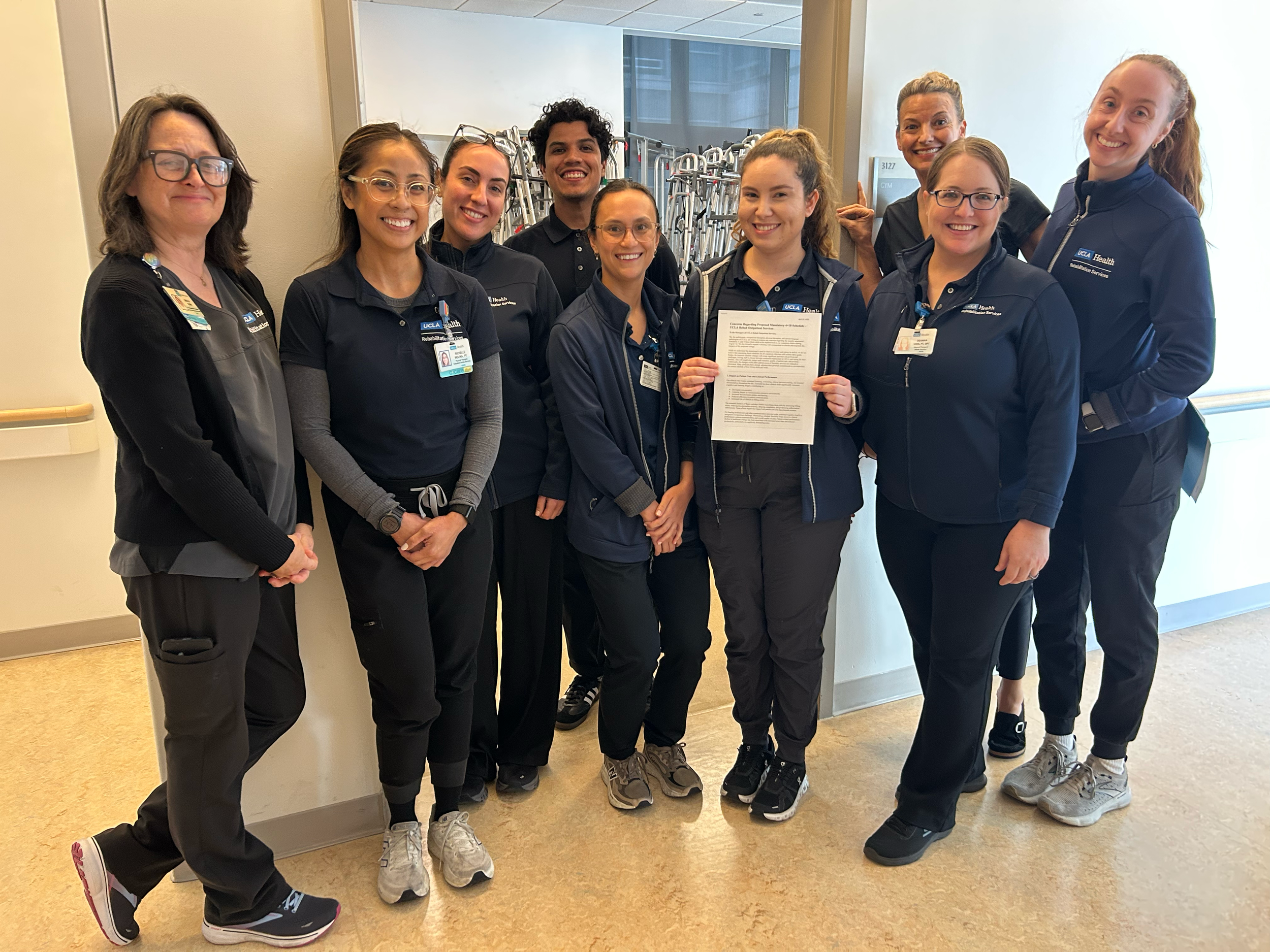
Keep UC Los Angeles rehab schedules flexible and protect quality care
UCLA management plans to force an entire unit of more than one hundred outpatient rehab clinicians onto a mandatory 4×10 schedule starting Saturday, August 1, 2026, putting patients, working families, and hard-to-replace specialized care at risk.
We ask that management keep the 4×10 schedule voluntary, preserve the 5×8 option, and negotiate the impacts directly with staff.
-
University of California, Los Angeles management plans to force every outpatient rehab clinician onto a mandatory 4×10 schedule—four ten-hour days per week—starting Saturday, August 1, 2026, replacing the five eight-hour days they work now.¹
This change affects more than an entire unit of more than one hundred outpatient rehabilitation clinicians who care for UCLA patients: the audiologists, occupational therapists, physical therapists, and speech-language pathologists who run the outpatient clinics. Many have built their childcare, commutes, and family lives around the current schedule.²
More than 75% of UCLA’s outpatient rehab clinicians, including many who have volunteered to take on the 4×10 schedule themselves, have signed a letter asking management to keep the change voluntary.
Management says longer days will raise revenue. But mandatory ten-hour days across the board force experienced clinicians to choose between keeping their jobs and caring for their families. If the department cuts Saturday hours to make the new schedule work, patients lose access to care, too.
The mandate also threatens specialized care that patients can’t easily find elsewhere: pelvic floor and pediatric therapy, cochlear implant care, aural rehabilitation, and treatment for complex voice and airway disorders. These are skills no employer can quickly recruit or replace.³
¹ Outpatient Rehab Staff, “Concerns Regarding Proposed Mandatory 4×10 Schedule—UCLA Rehab Outpatient Services” (letter to the managers of UCLA Rehab Outpatient Services, April 22, 2026), 1.
² Outpatient Rehab Staff, “Concerns Regarding Proposed Mandatory 4×10 Schedule,” 5–8.
³ Outpatient Rehab Staff, “Concerns Regarding Proposed Mandatory 4×10 Schedule,” 4.
-
Management’s scheduling change puts patients, working families, and the quality of care across UCLA’s clinics at risk:
Patients get worse care. Rehab work demands hours of focused listening, counseling, hands-on treatment, and careful documentation. Ten-hour days wear clinicians down, and fatigue leads to slower notes, delayed insurance authorizations, and a higher risk of clinical and billing errors—problems that directly affect patients.⁴
The budget math doesn’t work. Longer days don’t create more revenue. If people keep canceling or missing appointments at the same rate, the clinic books no more billable visits than before. And if management hires extra staff to fill the new hours, payroll climbs without the revenue to match.⁵
It exposes UCLA to legal risk. State and federal law, including the Americans with Disabilities Act of 1990, treat a modified schedule as a basic accommodation for workers with disabilities or medical conditions, and they protect employees with caregiving duties from policies that single them out. A blanket ten-hour mandate would trigger a flood of accommodation requests and open the door to discrimination claims.⁶
It punishes working parents. Most childcare runs eight hours a day. A ten-hour shift plus a commute can demand 11 to 13 hours of coverage—more than most providers offer. Parents of young children, new mothers, and employees who are still breastfeeding would carry the heaviest burden.⁷
It drives skilled and experienced clinicians out the door. Forced long shifts burn people out and push them to leave. Replacing a specialist takes months of recruiting and training, and while that seat sits empty, patients wait longer, and the clinic loses the money the schedule was meant to save.⁹
When management forces this schedule, everyone loses: patients wait longer for care, working families get squeezed, and UCLA loses experienced clinicians, revenue, and the trust of its own staff.
⁴ Outpatient Rehab Staff, “Concerns Regarding Proposed Mandatory 4×10 Schedule,” 1.
⁵ Outpatient Rehab Staff, “Concerns Regarding Proposed Mandatory 4×10 Schedule,” 2.
⁶ Outpatient Rehab Staff, “Concerns Regarding Proposed Mandatory 4×10 Schedule,” 2.
⁷ Outpatient Rehab Staff, “Concerns Regarding Proposed Mandatory 4×10 Schedule,” 3.
⁸ Outpatient Rehab Staff, “Concerns Regarding Proposed Mandatory 4×10 Schedule,” 3–4.
⁹ Outpatient Rehab Staff, “Concerns Regarding Proposed Mandatory 4×10 Schedule,” 4.
-
We are asking UCLA management to keep scheduling flexible and to sit down with staff to work out the details before making any changes.
Here’s what needs to happen:
Make the four-day, ten-hour schedule a choice, not a mandate. Let clinicians opt in.
Keep the five-day, eight-hour schedule for those who need it.
Honor the disability and medical accommodations the law requires, and give temporary exemptions to new parents and employees with infants.
Meet with staff regularly to design solutions that fit each specialty and to track what actually improves care and access.
Delay implementation until we have exhausted other avenues for addressing the root issues.¹⁰
¹⁰ Outpatient Rehab Staff, “Concerns Regarding Proposed Mandatory 4×10 Schedule,” 5.
-
A group of employees founded University Professional and Technical Employees (UPTE) in 1990, believing that workers across the University of California and at Lawrence Berkeley National Laboratory would benefit from a union to safeguard and expand their rights. In 1993, UPTE members voted to affiliate with the Communications Workers of America (CWA), a 700,000-member union in the American Federation of Labor and Congress of Industrial Organizations (AFL-CIO), the largest federation of unions in the United States, and with the Strategic Organizing Center (SOC), a North American national trade union center.
Key milestones:
1990:UC employees form University Professional and Technical Employees.
1993: UPTE votes to affiliate with the Communications Workers of America, becoming CWA Local 9119.
1994: 4,000 UC technical employees voted for UPTE representation.
1996: 3,700 UC research professionals joined UPTE.
1997: 2,000 UC healthcare professionals joined UPTE.
2025: UPTE reached a tentative agreement with the University of California and Lawrence Berkeley National Laboratory, and members voted to ratify it, with nearly 12,000 members participating in the ratification vote, with 98% voting in favor.
2026: A majority of 2,100 technical workers at UC voted to join UPTE, making us the largest tech-worker union in the United States, with 8,400 workers in the Technical Employees (TX) bargaining unit.
UPTE has grown to over 25,000 members as UC’s Medical Centers have expanded and as the union has added new titles to all of its bargaining units.
UPTE contracts also cover part-time, adjunct, and associate faculty, as well as counselors and librarians, at Butte College, College of the Sequoias, and Mt. San Jacinto College.
“Mandating ten-hour shifts is an unreasonable burden on employees, patients, and the organization itself. For staff with families, a ten-hour shift means being away from home for 12 to 13 hours once commuting and breaks are factored in—real, daily hardship for parents juggling childcare, school schedules, and the basic responsibilities of family life, including for me and my spouse, who both depend on predictable hours to keep our household running. The personal toll is only part of it: research consistently shows that extended shifts in healthcare settings increase fatigue and the risk of clinical error, and rehabilitation therapists do demanding, hands-on work. Fatigued therapists are less effective therapists, and that means worse outcomes for patients. If the goal is better coverage or productivity, there are smarter paths: rotating schedules, staggered shifts, or voluntary extended-day options that respect individual circumstances. I'm asking management to reconsider, not for convenience, but because a blanket 10-hour mandate is neither sustainable nor fair.”
Daniel Salazar, PT, DPT
Physical Therapist 2
UCLA Health 15th Street Plaza Family Medicine & Internal Medicine
“As a physical therapist, my work demands sharp analytical skills, active listening, and deep empathy. Every day brings a rigorous mix of physical, emotional, and mental challenges, and while the work is deeply rewarding, it requires sustained focus to stay safe and effective. Extending the workday from 8 to 10 hours, and raising the patient load from 13 to 16 people, will directly harm the quality of my clinical care. For UCLA to sustain its standard of medical excellence, it must care for its clinicians. We cannot care well for others if our own institution fails to support us.”
Carole Netter, PT, MS
Physical Therapist 3
UCLA Health Westwood Rehabilitation Services
“Today I’m saying goodbye to a longtime work friend and fellow parent who, after more than 10 years at UCLA, is leaving. She can’t be away from her young son for 11 hours a day, so she's moving out of the area for a new job. Meanwhile, I'm still waiting for human resources to work with me on a schedule accommodation so I can care for family members with special needs. As a UCLA provider and a parent, I want both of those roles to be valued, but this new schedule is the opposite of what we've loved about building our careers here. For UCLA Health to stand behind its slogan ‘U Matter,’ work-life balance has to still mean something.”
Doug Hovey, OTR/L
Occupational Therapist 2
UCLA Health Santa Monica 12th Street Rehabilitation Services