

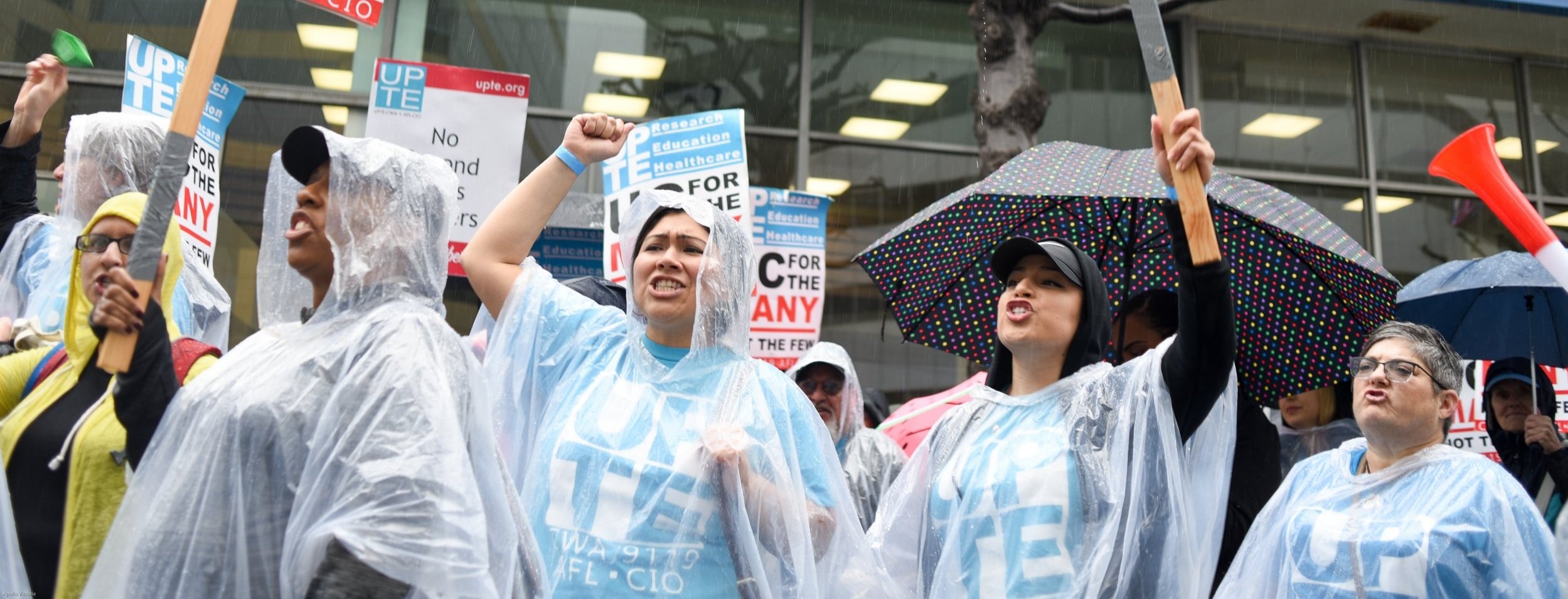
UCSD Health: Return to the table to improve staff retention and strengthen patient care!
Our UCSD Health colleagues working in unique shifts and conditions face distinct challenges that impact staff safety and retention, limiting our ability to provide the high-quality care we strive to deliver.
Those of us working evening, night, or weekend shifts are expected to do the same job as our daytime/weekday colleagues, but with far less resources and support. Many of us are mandated to work on-call shifts that interrupt our work/life balance and drive up already full workloads. We use bilingual skills, train interns and new staff, and work in high-risk settings (like prisons).
We face these challenges head on because we believe in the mission of our work and care deeply about our patients. UCSD Health’s current differentials fall below market standards, and countless UPTE-represented professionals have been left behind.
Yet, major competitors like Sharp Memorial Hospital started offering these differentials years ago. UCSD Health’s ability to recruit and retain staff for these critical shifts has suffered ever since.
We started negotiating solutions to this crisis in July, but UCSD Health Leadership has failed to see the urgency in ensuring our patients and colleagues have the staff necessary to maintain continuity of care.
We’re taking action.
Complete the sign-on letter below to demand UCSD Health address these inequities with the urgency our colleagues and patients need.
HEAR FROM IMPACTED UCSD HEALTH PROFESSIONALS
-
“I’m an evening shift pharmacist in our Jacobs Emergency Department. The evening shift differential needs to be increased for the good of the medical center and all the people we serve.
Our Emergency Department is 24-hours a day, nonstop. Our goal is to provide the best care all hours of the day, for any kind of care. Evening and night coverage in the ED is especially important because resources outside the ED are limited with urgent care and primary clinics being closed. This results in increased patient visits after hours.
Some of these patients have complex cases: from transplant and oncology, to stroke and cardiology patients. These are the patients who simply cannot afford suboptimal care. This is why it is critical to keep seasoned, well-trained staff on the evening and night shifts to support this level of acuity. When we lose a staff member and a shift goes short in the ED, one pharmacist can be responsible for over 100 patients. This is dangerous for both the patient and staff.
This is on top of the fact that not only have PM shifts been proven to be more taxing to the human body, but they isolate you from your community and your family. A better differential would entice interest in the evening shift and retain the seasoned pharmacists currently on these shifts. This would foster a more consistent and well-trained group of providers.
Unfortunately, we have lost far too many colleagues to the day shift. Our current evening differential of $2.20 does not incentivize any of my already overworked colleagues to pick up PM shifts, nor does it attract new pharmacists to join our team when our competitors are paying more with a higher differential. These shifts are staffed by a smaller group of employees, thus are more disrupted by individual losses. We need to attract more people to cover these shifts during sick calls and absences, which are notoriously hard to fill.
Ultimately, the evening shift differential has disappeared. It no longer differentiates between the day and evening shift to match the unique challenges of working the PM shift or the needs of our medical center. The evening shift differential must be increased to retain and recruit talented and hardworking staff.”
-
“After the bulk of patients, visitors, and staff go home for the evening, the hospital remains full of patients with the need for critical care. Though the hospitals seem quiet, clinical lab scientists (CLS) continue working in the labs, pharmacists remain on-site providing vital patient care, and social workers stay on in the ED 24 hours a day, 7 days a week, 365 days a year. Although this is not an extensive list of our night shift workers, each of us are instrumental in our own way to the functioning of the hospital.
People often don’t recognize the critical part care management plays in the hospital. We support patients with social inequities, helping them access shelter programs, case management and other community resources. Psychiatric emergencies don’t stop when the sun goes down. We are the ones that help place folks in psychiatric and substance use treatment hospitals all hours of the day.
On the night shift, we see increased visits from victims of abuse, human trafficking, and domestic violence. We help them get placed in temporary housing accommodations with their children. We also see dementia patients that come into Hillcrest wandering and confused, we ID them and connect their families with caregiver resources.
Social workers are designated support in crisis situations. We respond to Code Blues alongside doctors and nurses to support patients and families. We serve as the liaisons to communicate with the families as we help them navigate these stressful processes. That being said, at night there are less resources inside and outside the hospital. This makes it even more critical for our seasoned staff to stay on these shifts to provide patient expertise.
We are so foundational to the hospital that they will hold patients in the ED until a social worker or case manager arrives in the morning to access and support the patient. When this happens for our psychiatric patients, we lose critical time getting treatment placement.
A couple years ago, they offered shift differentials at Sharp Memorial. We lost half of our Hillcrest ED social work staff because they offered a differential and we didn’t. Our positions sat vacant for over a year before it was filled. Imagine how many patients had to sit in the ED overnight waiting for care because of this.
Ultimately, on some graveyard shifts, CLS are isolated working in the lab alone. Graveyard pharmacists face high volume with low staff, yet both of my colleagues get paid an extra $4-5 to work these shifts. Now, this rate must be raised as inflation and cost of living increases. With that being said, why are we not awarded the same differential working the same hours, in the same hospital, serving the same patients? This differential comes down to justice and equity for UPTE members.”
-
“The weekend differential is critical for long-term staff and patient safety, as well as staff sustainability and retention.
Patient acuity and volume are no different than on weekdays, but staff must meet 100% of patient needs with 50% or less of weekday staffing. Therefore, staff across job titles are expected to work “collapse shifts” where they are expected to cover as many as 4 units (as opposed to 1 or 2 during the week). This demands significantly higher cognitive load. For example, moving directly from treating a patient in the neuro ICU to another on the oncology unit. This alone would justify a substantial weekend differential — but we also need to account for unforeseen circumstances like sick calls.
Care management (case managers and social workers) has faced an ongoing staffing crisis that leaves staff with limited to no ability to use accrued vacation time. This lack of access to vacation time already places staff at higher risk of making errors, while additionally driving a high rate of callouts, with serious consequences for patients, including delayed discharges and inadequate response to patients in crisis.
Pharmacists and rehab therapists face similar problems: shifts left empty by sick calls or medical leaves often go unfilled, since no one volunteers to cover them. Pharmacists will take double the volume of patients on the weekends. Understaffing across job titles on the weekends leads to patients sitting for up to two full days, waiting for Monday's procedure or imaging.
Unmanageable workload is one of the top drivers of burnout. An appropriate weekend differential would help address this by incentivizing staff to pick up weekend shifts — ensuring appropriate staffing levels and the safety of our patients.”
-
“On-call pay matters because being available isn't nothing - it's work, even before anyone picks up the phone. If you're carrying a pager or laptop and have to be ready to jump in and fix something, that shapes your whole day (or night). You can't be social, you can't go somewhere with a bad signal, you're sleeping with one ear open, and you might have to bail on your child's school events at a moment's notice. Healthcare and tech employers pay for on-call status industry-wide because they recognize that being tethered has a cost, separate from whatever work actually happens once the call comes in.
Without on-call pay, staff is being asked to hand over their personal time for free so operations keep running smoothly.
How being on-call impacts us:
Work-life balance: On-call falls on holidays and weekends just like anyone else's while other coworkers get to fully check out. Some UPTE members get paid for giving up that time. Others carrying the same load don't.
Recovery: Being on-call disrupts schedules – requiring you to stay alert enough to hear the phone at all hours and there's no built-in recovery time afterward.
Retention and sustainability: Unpaid on-call burden quietly pushes people out the door. If you're not being compensated for the same load your coworker gets paid for, or you just feel like your personal time doesn't count, you go find an employer who does pay for it. That's especially expensive to lose in technical roles - where it takes years to build up that expertise.
Disparity in treatment: Clinical lab scientists and pharmacists get a 25% on-call differential right now. Other UPTE members with equivalent on-call responsibilities, including staff keeping critical systems running, get zero for the same trade-off.
Disparity within UPTE-represented ED professionals:
CLS and Pharmacists: 25% on-call differential.
Other UPTE members: 0% - despite carrying on-call obligations that look basically the same: same availability requirements, same response-time expectations, same after-hours system access.
Fundamentally, the on-call work isn't different for these groups. The pay is. It has been agreed that on-call time is worth money - but that logic has not been applied consistently across the unit.
The intention of on-call is to be a backup plan for rare, unpredictable issues - not a way to cover gaps in staffing. Leaning on unpaid or underpaid on-call to get extended-hours coverage without paying what actual staffing would cost is damaging to existing staff. The cost is pushed onto employees' personal time, and it gives zero incentive to fix staffing levels when on-call folks are forced to absorb the gap for free. Constant on-call drains staff – preventing them from being on top of their game and efficiently resolving issues that could lead to a negative impact on patient care.”
-
“At UC San Diego, we offer several medical specialty academic internship programs which cultivate newly graduated students into healthcare workers ready to enter the workforce and serve our community.
Several UPTE-represented titles work in fields which offer such programs. Dietitians, clinical laboratory scientists, pharmacists, and social workers are all UPTE titles whose job duties require the training and education of students and interns enrolled in programs at UCSD. Giving back to our professions by training students can be a rewarding experience as a healthcare worker, however the time we spend precepting students does come at a cost.
Our workloads are not reduced when students are placed with us. Using myself as an example, I have the same number of patients on my caseload the weeks I have a student versus the weeks I don't. When I have a student, all of my regular work tasks still have to be completed. Charting, meeting with patients or their families, teaching education groups, teaching cooking classes, attending interdisciplinary meetings. Days that we have a student are almost assuredly longer days at work. Some of our personal work tasks have to wait until our interns’ needs are met.
The role of being a dietitian preceptor is to teach the skills necessary to work in our various health specialties and settings, though students may or may not be in a rotation long enough to actually see patients on their own or reduce any daily tasks from their RD preceptors. A lot of time is spent answering their questions, as well as evaluating their skills via assigned projects and exams.
The UCSD Dietetic interns pay a tuition to UCSD which presently costs $10,000 per student, and we enroll 10 students each year. Across the 10 students, UPTE dietitians precept student interns for almost 12,000 hours collectively across various sites, most of which come directly from my dietitian colleagues in both the inpatient and outpatient settings. In addition to these hours, some of us assist in the internship interview and selection process before the year begins. None of this additional work is factored into our pay.
Being a teaching hospital allows us to teach the next generation of healthcare workers quality care. And while we take pride in being able to provide this service to the university and to our community, UPTE members need to be compensated for the additional time we spend precepting students and supporting UCSD’s internship programs.”
-
“As a fluent Spanish speaking therapist, I can attest that getting mental health treatment in your native language is essential. Quality of care and outcomes improve dramatically. Patients feel more comfortable sharing openly. It leads to a higher efficacy of treatment.
UCSD hosts thousands of students from around the world, 1 in 5 students are international. During peak times, UCSD students can wait 4-8 weeks to see a Mandarin-speaking or Spanish-speaking therapist. These are students that already face cultural and socioeconomic barriers that lead to decreased access and need support in a shorter timespan.
To access services before then, clients are forced to involve a third-party telehealth interpretation service that always comes with a series of delays. We face consistent technical issues, miscommunication, delays, leading to confusion and frustration for the patient. Not only is this overall demoralizing for the client, but it is dangerous when it comes to retention, risk assessments and legal requirements. Therapists and clients in crisis need to have a clear line of communication to discuss risk of suicidality, intent, and access to means. We are legally obligated to ensure that clients understand limits of confidentiality and for phone and video visits, we must be able to confirm the address of their current location for safety intervention in case of a mental health emergency.
To support UCSD clients the way they deserve, it is essential we retain our multilingual providers while recruiting new talented providers. We have lost far too many great bilingual providers because they were not being compensated for their additional and essential language skills, labor, and value. In addition to providing improved access and quality of care, bilingual providers also perform additional labor of mentally translating assessments into another language and back from the other language into documentation in English.
Cultural brokering and knowledge is another value added to the quality of services and improved outcomes. If the skill is valuable enough to advertise or require during recruitment, it is valuable enough to compensate upon hiring. Not compensating clinicians for their additional skills and value is a disservice for both the patients and staff that are left with delays and decreased access to care, an inequitable burden of labor, and unstable staffing.
Alongside therapists, it’s essential to protect our other bilingual providers in the hospital. Accessing healthcare in your native language is critical to understanding your care plan and a timely recovery. Patients deserve to have full comprehension of their diagnosis, which is only possible in a language they can fully understand. Failing to understand and complete all aspects of your treatment plan ultimately results in longer recovery times, missed follow up treatments, and potential returns to the hospital.
In the middle of the night when there have been challenges to get translation services for our patients, our bilingual ED social workers have stepped up to provide language services impromptu because of how critical it is for patients to receive care in their native language. This is the behavior that goes above and beyond that makes UCSD a great place to receive care. It deserves to be compensated alongside our talented multilingual therapists and providers. We can ensure this happens with a bilingual differential.”
-
“I’m an inpatient social worker in La Jolla, and sometimes Hillcrest.
Our care management teams are the backbone of the hospital, keeping patients moving through the care system. The lack of staff delays the entire system. The continued staffing crisis within care management results in longer wait times for patients, longer discharge time, and ultimately more time spent in the hospital than needed.
Our hospitals have faced an on-and-off staffing crisis since the pandemic, rarely maintaining a period of stability longer than a couple of months within a singular department. When a department is unstable and colleagues at another location need support, local management temporarily reassigns social workers, case managers, clinical lab scientists, pharmacists, and IT workers to other locations.
Many of us can’t afford to live in La Jolla or the other neighborhoods in which we work. Some UPTE members commute as far as Tijuana to work at UCSD and support their families. Last minute or short term adjustments to our schedule disrupts our families’ lives. Many of us take care of family members and/or children. This differential will mitigate additional costs for childcare and commuting.
Across job titles at UCSD Health, short staffing results in delays in care. Meaning, the one who truly loses most from short staffing is the patient. Our goal with this differential is to reward our colleagues that step up and lend a hand at our other locations when they need it most.”